
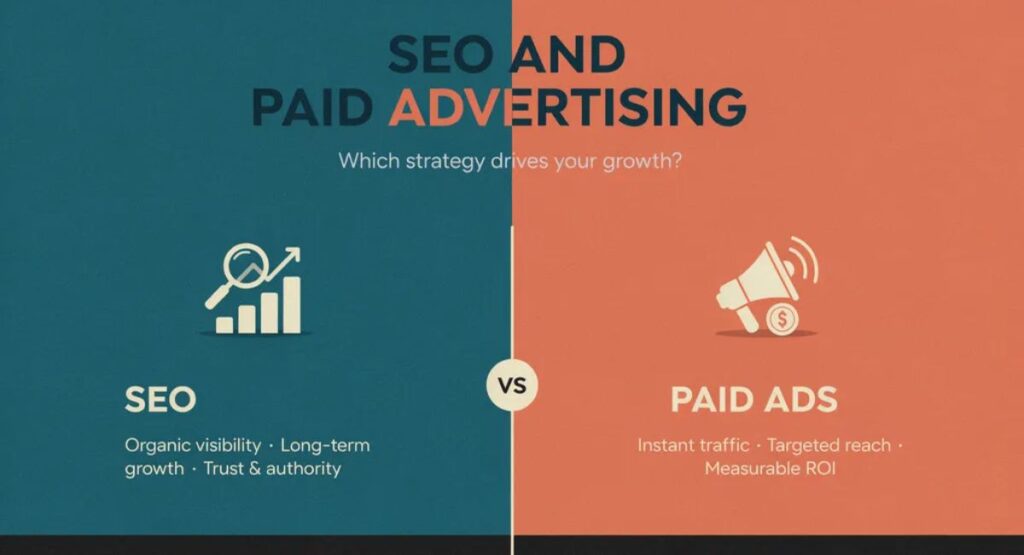
Businesses often treat SEO avd paid advertising as competing strategies. In reality, they solve different problems. One builds long-term visibility, while the other delivers immediate traffic.
The real decision is not about choosing a winner. It’s about understanding which approach aligns with your growth stage, cash flow, and acquisition goals.
Two Different Ways to Generate Traffic
SEO and paid ads both aim to bring users to your website, but the mechanics are completely different.
SEO services improve organic rankings by enhancing content relevance, technical performance, and overall site authority. Once pages rank, they can attract ongoing traffic without direct payment per visit.
Paid advertising, on the other hand, buys visibility. Google Ads and Meta Ads allow your message to appear immediately in front of users through targeting rules and auction-based bidding systems.
One builds equity in search presence, the other rents attention.
When ROI Feels Better with Paid Advertising
Paid campaigns often appear more effective in the short term because results are immediate.
You can launch a campaign today and start receiving clicks within hours. This makes it especially useful when timing is critical.
Paid advertising tends to perform well in situations such as:
- Product launches that need instant visibility
- Seasonal promotions with fixed deadlines
- Testing new offers or markets
- Driving traffic to time-sensitive landing pages
For example, an e-commerce brand running a weekend discount can use paid ads to generate quick demand without waiting for organic rankings to improve.
However, performance stops the moment spending stops, which limits long-term ROI unless campaigns are continuously optimised.
Why SEO Builds Value Over Time
Unlike paid ads, SEO compounds.
A well-ranking page can continue attracting visitors for months or even years with minimal additional cost. This creates a different type of return — one that grows gradually rather than immediately.
Strong SEO performance often results in:
- Consistent organic traffic
- Lower dependency on paid channels
- Higher trust from users clicking organic results
- Improved visibility across multiple search terms
For example, a service business ranking for “IT support for small businesses” can receive steady enquiries without paying for each click.
The trade-off is time. SEO requires consistent effort before results become visible, especially in competitive markets.
Comparing ROI in Real Terms
ROI depends on how you measure success.
Paid advertising focuses on cost per acquisition (CPA) and return on ad spend (ROAS). You can calculate performance quickly because the data is immediate.
SEO emphasizes the lifetime value of traffic rather than short-term gains. Once rankings improve, each additional visitor costs less to acquire over time.
This leads to a key difference:
- Paid ads optimise for speed and predictability
- SEO services optimise for sustainability and compounding value
Neither is inherently better. They simply measure success differently.
Where SEO Has a Clear Advantage
SEO tends to outperform paid channels when:
- Customers research before buying
- Trust plays a major role in conversion
- Search demand is consistent over time
- Businesses want to reduce long-term acquisition costs
Industries like professional services, SaaS, healthcare, and education often benefit because users rely heavily on search results when making decisions.
In these cases, organic visibility becomes a long-term asset rather than a short-term tactic.
Where Paid Ads Still Win
Paid advertising is stronger when speed and control matter most.
It is particularly effective when:
- Immediate leads are required
- Demand needs to be created quickly
- Campaigns depend on tight deadlines
- Audiences must be segmented precisely
A startup validating a new product, for instance, can use paid campaigns to test messaging and measure demand without waiting for SEO traction.
The Cost Reality Most Businesses Miss
Many people make the mistake of comparing SEO and paid advertising based solely on their initial costs.
Paid advertising looks expensive because you see every click priced individually. SEO feels cheaper once it is running, but it requires upfront investment in content, optimisation, and technical improvements.
A more accurate comparison is:
- Paid ads = ongoing cost for ongoing traffic
- SEO = upfront effort for long-term traffic potential
Over time, SEO can reduce overall dependency on paid channels, but it rarely eliminates the need for them.
How Data Connects Both Channels
Although different, SEO and paid ads can inform each other. Paid campaigns provide fast data on:
- High-converting keywords
- Effective messaging
- Audience behaviour
This information can guide SEO content strategy. Strong SEO results often reveal long-term growth opportunities that can be further scaled using paid advertising.
When used together, they create a feedback loop that improves overall marketing efficiency.
A More Balanced Growth Strategy
Most businesses don’t rely on just one channel for a reason.
A combined approach often produces stronger results:
- Paid ads drive immediate traffic and testing
- SEO builds long-term visibility and credibility
- Insights from both improve targeting and messaging
For example, a company may use paid ads to identify which services generate the highest conversion rates, then build SEO content around those topics to sustain long-term traffic.
Final Thoughts
SEO and paid advertising are not competing strategies; they are complementary ones with different roles in a growth system.
Paid campaigns deliver speed and control, while seo services build long-term visibility and compounding value. The right choice depends on whether your priority is immediate performance or sustainable growth. In most cases, businesses achieve the strongest ROI not by choosing one over the other, but by understanding how both contribute to a broader acquisition strategy.