
AP Automation & Machine Learning is altering the way financial teams in the US deal with payments, approvals, and invoicing. Businesses increasingly utilize accounts payable automation, AP automation, and AI-powered AP automation to speed up workflows and lower expensive errors rather than depending on labor-intensive, inefficient processes.
Invoice data is automatically collected, verified, and approved with the aid of machine learning in accounting. As a result, finance departments gain greater control and real-time visibility in their processes. Moreover, this transition allows organizations to handle higher invoice volumes, improve accuracy, and make better-informed financial decisions. At the same time, it achieves this aim without increasing operational complexity or headcount, ultimately supporting a complete digital transformation.
What Is AP automation and why It matter?
The term “AP Automation & Machine Learning” denotes the utilization of software to facilitate the capture, validation, approval, and payment of invoices with minimal human intervention. In practice, invoice automation replaces manual data entry with OCR invoice processing, invoice recognition software, and automated invoice processing that reads invoices as soon as they come in. Finance teams can process invoices in real time, make fewer mistakes, and see more clearly across departments and vendors.
For American businesses, this change helps with the digital accounting transformation and better finance automation tools. Automation keeps things moving quickly without losing accuracy as volumes rise and teams become more mixed. It also makes accounting workflow efficiency and tightens internal financial controls, which gives leaders the confidence to make financial decisions based on data.
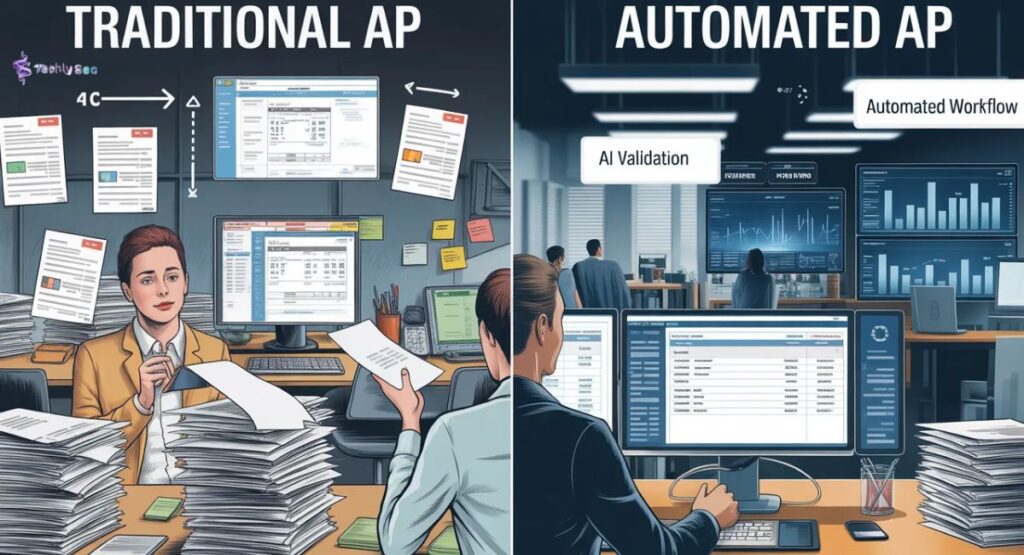
Key Challenges in Traditional Accounts Payable Processes
Paper, email threads, and spreadsheets are what traditional AP uses. These tactics make it take longer to get approvals, hide problems, and raise the risk. Manual processes make it easier for hackers to steal financial information and make it harder to find fraud. When documents are stored in inboxes instead of a central document storage system, teams have a hard time managing the lifespan of invoices.
Another challenge is scale. As invoice counts rise, costs increase and errors multiply. Teams can’t keep the productivity of the finance team or make sure compliance automation works without automating the accounting process. This is why U.S. finance officials now put a lot of emphasis on automating financial workflows and going paperless.
How AP Automation Works (Step-by-Step)
The process of modern AP automation commences with the capture of invoices via email, portals, or e-invoicing. Intelligent document processing (IDP) is employed to accurately read and classify data in invoice data extraction. The system validates amounts, vendors, and tax details through automated financial validation, reducing rework.
Next, invoices move through automated approval workflows with automated approval routing based on rules. Once approved, payments run through e Payments or virtual cards payments, then sync via ERP integration. The result is faster cycles, clean audit trails, and accounting system integration that supports enterprise finance automation.
Role of AI and Machine Learning in AP Automation
AI in accounting powers smarter decisions at scale. Machine learning in accounting learns vendor formats and improves accuracy over time using machine learning invoice classification and AI-based invoice interpretation. This enables smart invoice processing even with complex layouts.
AI also enhances controls. Duplicates or unusual amounts are identified through anomaly detection in invoices, while predictive analytics in finance facilitates the optimization of cash flows. In conjunction, these capabilities establish AI-driven accounting workflows that enhance the optimization of financial processes and fortify secure financial automation.
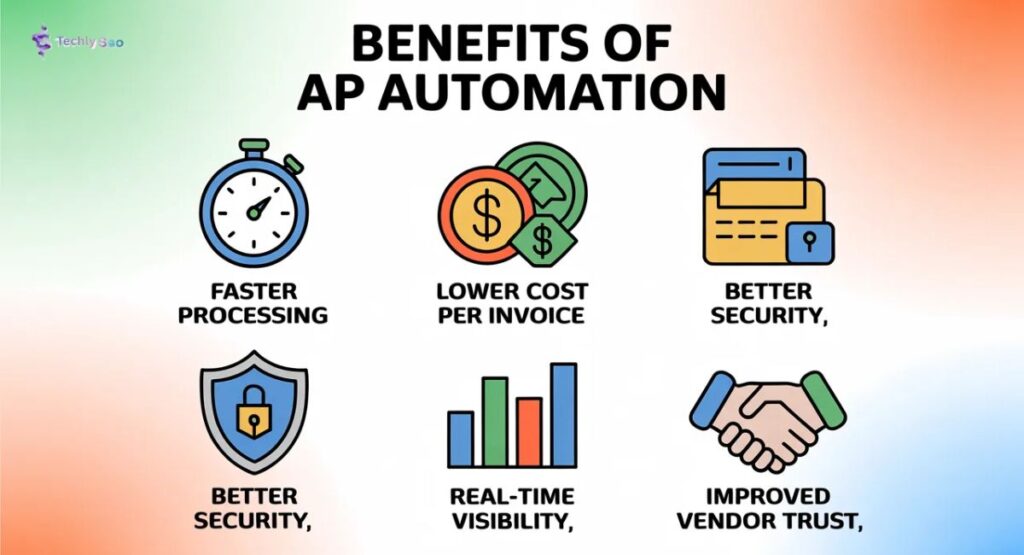
Benefits of Accounts Payable Automation for Businesses
The adoption of accounts payable automation by businesses results in reduced costs and faster cycles. Industry benchmarks indicate that the cost per invoice decreases significantly, while the time required to process invoices decreases from weeks to days. This improves digital finance operations and supports scalable finance systems.
Vendors benefit too. On-time payments improve trust and unlock early-pay discounts. With historical financial data analysis, leaders gain insights into spending and performance. These gains fuel accounting digital transformation and sustainable growth across global finance operations.
How AP Automation Benefits Finance Teams and Departments
For teams, automation reduces burnout. Robotic process automation (RPA) and automated bookkeeping eliminate repetitive tasks, thereby enabling individuals to conduct analysis. This enhances the productivity of the finance team and boosts morale, particularly during peak periods.
Different roles gain clarity. AP clerks see fewer exceptions, managers track real-time invoice processing, and CFOs rely on automated financial reporting for strategy. The shared view strengthens accounting digital infrastructure and finance process intelligence.
Compliance, Security, and Global E-Invoicing Regulations
Compliance is simpler with automation. Consistent logs and compliance automation that are in accordance with the requirements of the IRS and SOX are implemented by U.S. companies to enhance their audit readiness. Encryption and role-based access enhance the security of financial data.
E-invoicing standards and tax rules require businesses that do business around the world to be accurate. Automation supports global finance operations by standardizing processes while preserving local requirements. This balance protects growth and trust.
Digital Payments, Virtual Cards, and the Future of AP
Checks are fading fast. ePayments and virtual card payments deliver speed and security while reducing fraud risk. These methods integrate smoothly with cloud-based accounting software and modern ERPs.
Looking ahead, AP becomes touchless. AI finance software and pre-accounting automation will handle exceptions before humans notice them. The future belongs to teams that embrace accounting automation tools now.
How to Select the Right Accounts Payable Automation Software
Choosing software starts with fit. Look for strong ERP integration, flexible approvals, and proven invoice processing automation. The platform should support growth and accounting system integration without hidden costs.
Ask vendors about implementation and support. The best tools enable rapid onboarding and measurable ROI. When chosen well, AP Automation & Machine Learning become a long-term advantage, not just a tool.
Automation Impact Snapshot
| Metric | Before Automation | After Automation |
| Invoice cycle time | 7–14 days | 2–4 days |
| Cost per invoice | $15+ | Under $5 |
| Visibility | Limited | Full, real-time |
| Risk control | Manual | AI-assisted |
“Automation isn’t replacing accountants. It’s redefining their value.” — Tony Sacre, CEO, Allinial Global. AP Automation & Machine Learning is no longer optional for U.S. finance teams. It’s the foundation of accuracy, speed, and resilience in a digital-first economy.