
Computer vision machine learning helps computers do something that once felt impossible: see and understand the world like you do. When a system looks at a photo or a video, it doesn’t just store it. Instead, It learns from it instead. Computers can look at pictures, find trends, and make smart choices when they use computer vision technology and machine learning algorithms together.
This method makes daily gadgets like face unlock, medical scans, and smart cameras work. With strong visual data analysis and advanced image and video processing, artificial intelligence vision is quietly improving how businesses and people work across the United States.
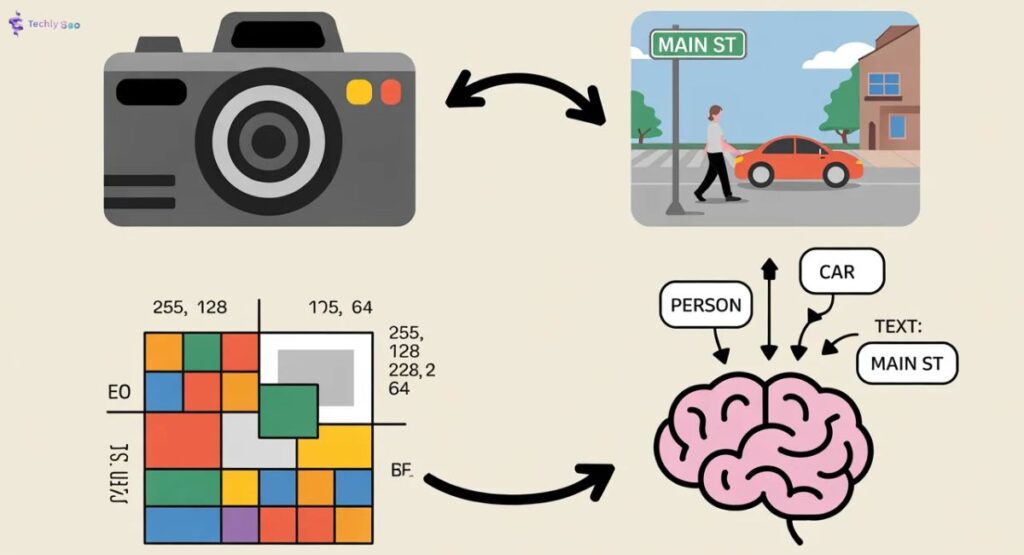
What is Computer Vision?
Computer vision is a subdivision of artificial intelligence dedicated to instructing machines in the comprehension of images and movies. Rather than merely storing photos, these systems emphasize the extraction of significant information from visuals through mathematical analysis, logical reasoning, and learning algorithms. This procedure integrates image and video processing, pattern detection, and visual-based decision-making.
In order to understand computer vision, consider telling an infant to identify animals. Over time, they develop an awareness of patterns, colors, and shapes. In a similar way, these systems employ machine learning algorithms and deep learning models to create smart image recognition system
A Brief History of Computer Vision
In the 1950s, academicians began to investigate whether computers could “see.” This was the beginning of the history of computer vision. Early systems had a hard time since computers didn’t have enough processing power or good data. Progress accelerated once researchers combined statistics with learning methods, opening the door to image classification models and early object detection techniques.
A major breakthrough came with large datasets like Image Net and the rise of GPUs. These advances pushed computer vision into real-world use, including medical image analysis and autonomous vehicle vision.
How Computer Vision Works
Every computer vision system starts with data Cameras, sensors, and scanners take pictures that are then processed with techniques like resizing, noise removal, and contrast correction. As aresult, accuracy improves and image datasets become easier for machines to learn from.
Next comes learning. Models operate feature extraction from visual input using convolutional neural networks layers, where filters and feature maps highlight edges, forms, and textures. Systems use loss function optimization to modify weights during a forward pass and backpropagation until predictions get better.
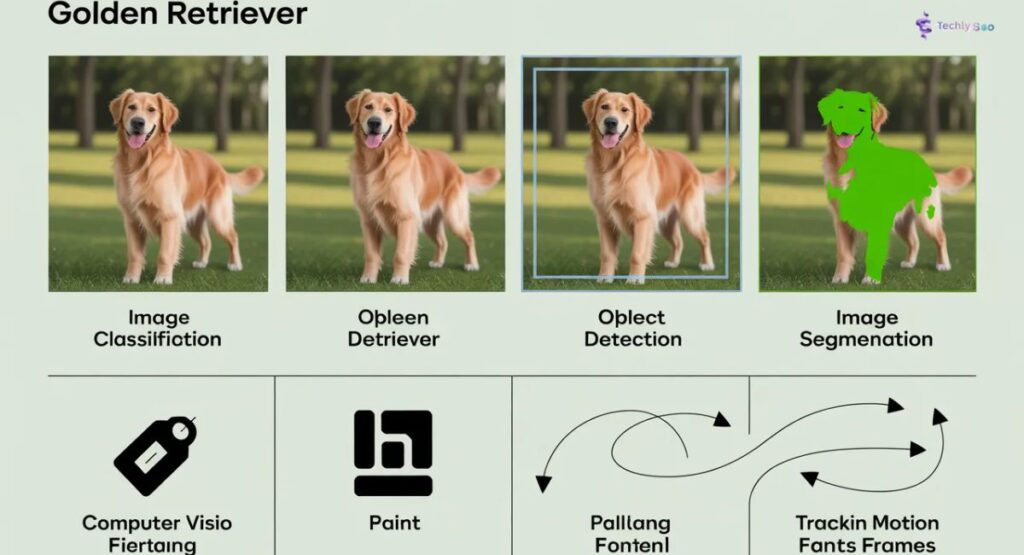
Core Computer Vision Tasks
This field covers many tasks, starting with recognition and understanding. Systems perform pixel-level image understanding to decide what appears in a scene. Tasks include classification, detection, tracking, and segmentation, all driven by supervised image learning and high-quality labeled training data.
Advanced tasks go further. Pixel-wise classification helps machines understand exact boundaries. Scene understanding and relationships allow models to infer actions and context, such as traffic flow. These tasks form the base of real-world computer vision applications seen across US industries.
Computer Vision vs Machine Learning
Although computer vision and machine learning frequently intersect, they are not identical. Machine learning is a comprehensive discipline that enables systems to identify patterns in data. Computer vision is everything about visual In practice, computer vision uses machine learning as its engine.
In simple terms, computer vision can be compared to the eyes, while machine learning can be compared to the brain. Vision systems employ machine learning algorithms to interpret motion, shapes, and pixels.
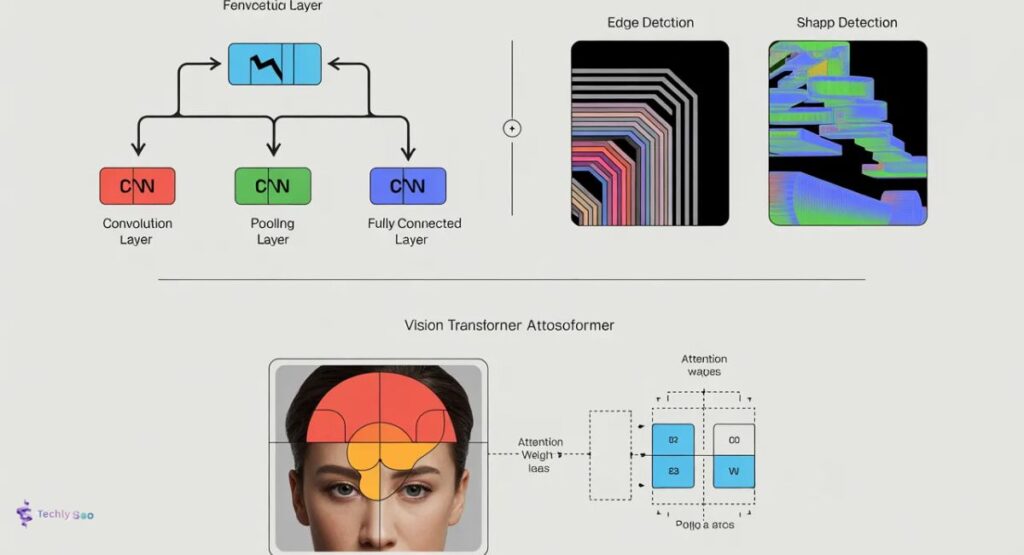
How Machine Learning Enhances Computer Vision
The performance of vision systems is significantly enhanced by machine learning. Models are able to learn intricate patterns with the assistance of deep networks, particularly CNN architecture. A self-attention mechanism is employed by new approaches, such as vision transformers (ViT), to concentrate on critical components of an image, even when the scene is vast.
These advancements also boost vision language models (VLMs), which establish a connection between text and images. With transformer-based vision models, systems now describe images, answer questions, and generate visuals using generative adversarial networks and diffusion-based image generation.
Applications of Computer Vision Across Industries
Computer vision in healthcare increases diagnostics by analyzing photographs with precision and speed. Vision systems are used by radiology teams for medical image analysis, which helps find diseases earlier. The FDA talks about progress in AI images here: https://www.fda.gov/medical-devices.
In transportation, autonomous vehicle vision uses real-time object detection and bounding boxes and localization to navigate roads. Manufacturing benefits from computer vision in manufacturing, where visual inspection systems enable automated defect detection using high-resolution image analysis. Retail, agriculture, and security also depend on vision daily.
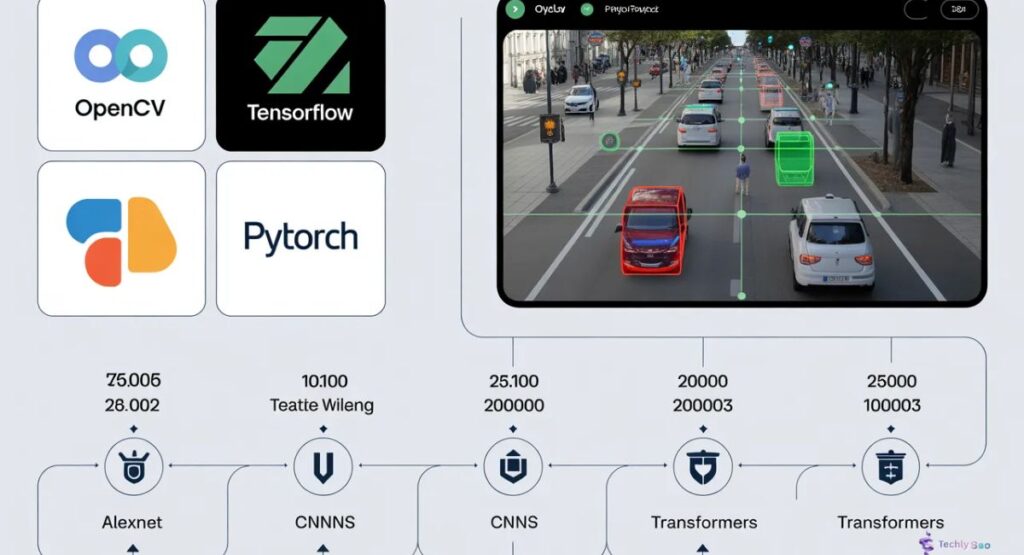
Popular Computer Vision Tools and Frameworks
Developers rely on powerful libraries to build vision systems. The OpenCV library remains a favorite for prototyping and production, offering tools for tracking, filtering, and recognition. TensorFlow and PyTorch dominate deep learning, with TensorFlow computer vision and Py Torch computer vision supporting scalable models.
The table below compares common tools used in US-based projects.
| Tool | Most Effective Case | Power |
|—–|————-|———-|
| OpenCV | Processing images| Fastness and flexibility |
| TensorFlow | Production AI | Scalability |
| Py Torch | Exploring | Trying out other models |
Business Benefits of Computer Vision Solutions
Businesses use computer vision to get better at what they do and be more efficient. Vision systems let people make fewer mistakes, make decisions faster, and find information that is concealed in pictures. This edge helps businesses stay competitive in US marketplaces that move quickly.
Beyond savings, computer vision creates new opportunities. From safer roads to smarter factories, it turns visual data into action. As Forbes notes, vision-driven AI will define the next decade of innovation: https://www.forbes.com/ai/.
Computer vision gives machines the power to see, and that power is reshaping every industry.”
If you want to future-proof your business, understanding computer vision is no longer optional. It’s essential.
FAQS
Q1: Is machine learning used in computer vision?
Yes, machine learning powers computer vision systems, enabling them to recognize patterns and interpret images and videos accurately.
Q2: Is computer vision a part of machine learning?
Computer vision often uses machine learning but is a distinct field focused on analyzing and understanding visual data.
Q3: Is Computer Science or Computer Engineering better for AI?
Computer Science is generally preferred for AI careers, though Computer Engineering also provides a strong foundation in hardware and software.
Q4: What are the four types of machine learning?
The four types are supervised learning, unsupervised learning, semi-supervised learning, and reinforcement learning.
Q5: Is ChatGPT AI or machine learning?
ChatGPT is an AI system built using machine learning, specifically deep learning models that process language and generate responses.