
SEO for Contractors helps construction and home service businesses appear in front of customers who are actively searching for their services online. With the right strategy, contractors can improve search engine rankings, attract more qualified leads, and build stronger online visibility in competitive local markets.
From optimizing service pages to improving Google Business Profile listings, contractor SEO focuses on turning search traffic into real enquiries and booked projects. A well-planned approach also strengthens your contractor website and supports long-term growth without relying only on paid ads. For contractors, smart local SEO can become a reliable source of consistent business growth.
What Is SEO for Contractors and How Does It Work?
Contractor SEO improves a contractor website so search engines can crawl, understand, index, and display its pages for useful searches. A customer may search for a kitchen contractor in Dallas or roof repair in Tampa. Your pages need to clearly connect the service, location, problem, and solution.
A complete SEO strategy combines onsite SEO, technical work, local optimization, and offsite SEO. Your website code must remain accessible. Your service pages need useful information. Local signals should confirm where you work. Trusted mentions and backlinks can also help search engines understand relationships and relevance between pages and websites. (Google for Developers)
How Contractor SEO Connects Customers With Your Business
Think of SEO like road signs leading customers to your front door. The website may look fantastic, but it won’t help much when nobody can find the road. Better search visibility, clear service pages, useful location information, and strong website authority make that journey easier for both customers and search technology.
| SEO area | Main purpose | Business outcome |
| On-page SEO | Improve headings, content, titles, and internal links | Stronger relevance |
| Local SEO | Connect services with real service areas | More local customers |
| Technical SEO | Improve crawling, speed, security, and usability | Better site performance |
| Content SEO | Answer customer questions | More relevant website traffic |
| Off-page SEO | Build authority outside your site | Stronger trust and referral visibility |
Why SEO Is Important for Contractors
People searching for contractors usually have a clear problem. Some need an emergency repair. Others are comparing estimates for a major remodel. Appearing in relevant Google search results gives your contracting company a chance to enter that decision early. That makes SEO different from many forms of outbound leads, where you interrupt people who may not need your service.
Strong contractor marketing also needs durability. Paid media can create immediate visibility, while organic search can keep bringing visits after useful pages gain traction. Google confirms that advertising does not buy better organic positions. This makes SEO and advertising different tools rather than direct substitutes.
Contractor Businesses That Can Benefit From Search Visibility
Different trades need different pages because customer intent changes with the job. General contractors may focus on renovations and additions. Remodelers, electricians, flooring companies, restoration companies, roofers, HVAC contractors, landscapers, plumbers, and window and door companies each need service-specific content that reflects real customer questions.
| Contractor type | Typical customer intent | Useful page direction |
| General contractor | Large renovation or construction project | Service and project pages |
| Roofer | Repair, inspection, or replacement | Problem-specific service pages |
| Electrician | Installation or urgent fault | Residential and emergency pages |
| Remodeler | Kitchen, bathroom, or whole-home upgrade | Detailed remodeling guides |
| HVAC contractor | Repair, replacement, maintenance | Seasonal and service pages |
What You Get with Contractor SEO from Techly seo
Techly seo currently lists on-page SEO, off-page SEO, content writing and optimization, tailored strategies, and ongoing support among its services. For contractors, these elements should work together rather than operate as isolated tasks. An initial SEO audit can uncover technical problems, weak pages, missing topics, and conversion gaps. (Techly SEO)
A contractor-focused campaign should also use competitive analysis and competitive digital analysis to understand what competing businesses rank for and where opportunities exist. From there, website content optimization, content creation, campaign tracking, and analytics reporting can connect SEO activity with actual enquiries. That makes an SEO campaign easier to judge by business value rather than rankings alone.
Building a Contractor Marketing Strategy Around Real Goals
A useful contractor marketing strategy starts with your best services and actual service area. It shouldn’t chase every keyword on the internet. Instead, priorities should reflect profit, demand, competition, seasonality, and customer intent. That approach turns digital marketing for contractors into a focused growth system rather than a collection of disconnected tasks.
Benefits of SEO for General Contractors
Effective general contractor SEO can improve discoverability at several stages of the buying journey. A homeowner may first read a remodeling cost guide. Days later, the same person may search for a contractor nearby. Useful content can support both moments while strong service pages move interested visitors toward calls, consultations, and booked projects.
SEO also improves the digital foundation around the business. Better website rankings can increase discovery, while stronger content can build confidence. Over time, the combination may create more qualified leads, stronger brand recognition, and less dependence on a single advertising channel. However, results vary by market, competition, website quality, and execution.
A Reported Contractor SEO Case Study
One competitor-supplied case study for American Vintage Home reported more than 500 keywords on page one, a 10% year-over-year increase in validated SEO leads, and a 77:1 reported ROI after work that included tracking, content, optimization, and local directory improvements. These are vendor-reported results rather than results every contractor should expect.
| Reported metric | Reported result |
| Page-one keywords | 500+ |
| Year-over-year validated leads from SEO | 10% increase |
| Reported SEO ROI | 77:1 |
Local SEO for Contractors: How to Rank in Your Service Area
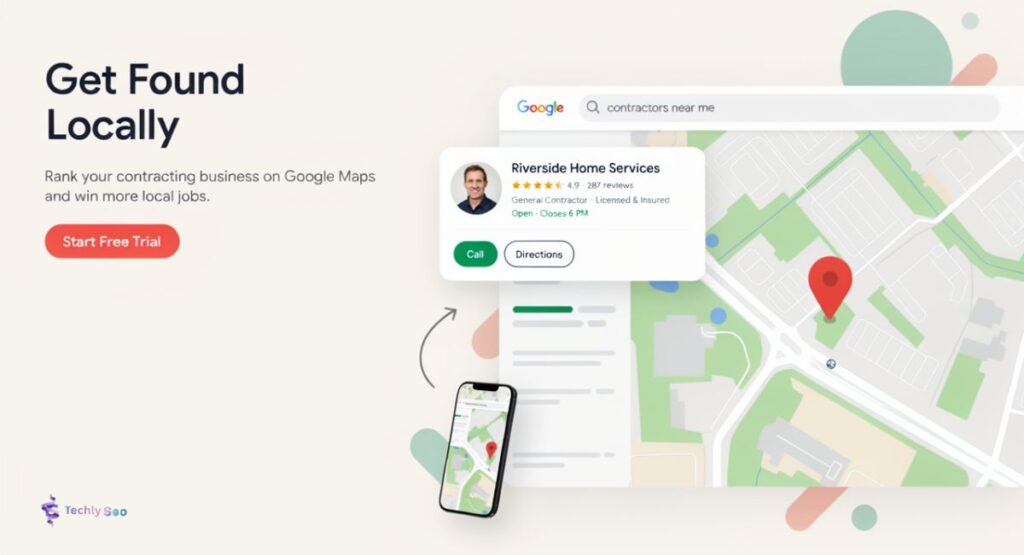
Local SEO for contractors focuses on helping nearby customers discover your business in Search and Maps. Start with an accurate Google Business Profile. Keep your category, hours, phone number, services, photos, and business details current. Google says local results mainly consider relevance, distance, and prominence. (Google Support)
Your website should reinforce those signals. Create useful pages for real areas you serve. Maintain accurate local citations across trusted directories. Ask genuine customers for reviews and respond professionally. This strengthens local search marketing while helping visitors confirm that your company actually provides the local services they need. (Google Support)
Google Business Profile, Reviews, and Local Citations
Google gives a useful reminder: “There’s no way to request or pay for a better local ranking on Google.” (Google Support) That means shortcuts aren’t the answer. Complete information, relevant services, real reviews, useful local pages, and consistent local citations give customers clearer reasons to trust your business.
| Local factor | What to improve |
| Relevance | Accurate categories, services, and page topics |
| Distance | Correct service-area information |
| Prominence | Reviews, mentions, links, and business recognition |
| Trust | Accurate contact details and authentic project proof |
Keyword Research for Contractor SEO
Keyword research begins with intent. Broad search terms may attract large audiences but produce weak enquiries. High-converting keywords usually reveal a clearer need. “Kitchen remodeling contractor in Phoenix” tells you far more about the searcher than “kitchen ideas.” Service, location, urgency, price, and project type can all reveal intent.
A strong keyword map also prevents several pages from competing for the same topic. Match service terms to service pages, city terms to useful location pages, and research questions to articles. Then use Google Search Console to discover queries already generating impressions and clicks. (Google)
Contractor SEO Keyword Intent Examples
| Search intent | Example keyword | Best content type |
| Immediate need | emergency roofer in Denver | Service page |
| Local provider | remodeling contractor Austin | Location/service page |
| Price research | bathroom remodel cost Chicago | Cost guide |
| Comparison | contractor vs handyman | Educational article |
| Project planning | how long does a kitchen remodel take | Detailed guide |
This structure helps a site pursue useful search rankings instead of collecting random keywords. The goal isn’t simply more impressions. The right terms should connect relevant searches with pages capable of generating SEO leads and real enquiries.
How to Optimize a Contractor Website for SEO
Good contractor website SEO starts with strong pages. Each major service deserves enough detail to answer real questions about the work, process, project type, service area, pricing factors, and next step. Clear titles, headings, internal links, and useful meta descriptions support better website optimization and stronger webpage content quality. (Google for Developers)
Technical quality matters too. Maintain strong website security and HTTPS. Improve mobile-friendliness, clean up heavy scripts, optimize page speed, and use optimized images. Google recommends responsive web design and encourages strong Core Web Vitals because they support a better user experience. (Google for Developers)
Technical SEO Improvements for Contractor Websites
Your foundational website improvements should make pages easy to crawl and easy to use. Schema markup can help Google understand business information, while tools such as PageSpeed Insights can expose performance problems. Structured data can clarify business details but doesn’t guarantee enhanced search features. (Google for Developers)
| Website area | What to check | Why it matters |
| Website code | Crawlability and clean structure | Helps discovery |
| Content length | Enough depth to answer the topic | Improves usefulness |
| Page speed | Slow images, scripts, and servers | Supports usability |
| Mobile layout | Buttons, forms, and readable text | Helps mobile visitors |
| Schema markup | Valid LocalBusiness information | Adds structured context |
| Internal links | Clear page relationships | Helps navigation and crawling |

Content Marketing Strategies for Contractors
Strong website content should answer the questions customers ask before they hire you. Explain costs, timelines, materials, permits, preparation, maintenance, and common mistakes. Google recommends creating helpful, reliable content primarily for people rather than pages designed only to manipulate rankings. That principle should guide every contractor content creation plan. (Google for Developers)
Real project experience can make content far more useful. Show what changed during a renovation, why one material worked better, or what affected the project timeline. Helpful before-and-after examples, service guides, FAQs, and cost explanations can strengthen your organic search presence while giving customers evidence that you understand the work.
Build Topical Authority Instead of Publishing Random Blogs
A roofing business, for example, could connect repair, replacement, inspection, storm damage, materials, and cost content. Each article supports related services through natural internal links. This creates a clearer content system and improves website content optimization without forcing the same keyword into every paragraph.
Useful content can also improve the click-through rate indirectly by giving you stronger page titles, better search snippets, and more relevant topics. Still, rankings are only part of the story. A page must persuade the right visitor to take the next step.
Off-Page SEO and Link Building for Contractors
Offsite SEO builds signals beyond your own domain. Useful mentions may come from trade organizations, local media, suppliers, industry publications, business associations, or community partners. Google states that links can help it discover pages and understand relevance. That makes legitimate quality backlinks more useful than mass-produced link packages. (Google for Developers)
Treat link building like reputation building. A genuine project feature in a local publication can bring referral traffic and recognition. A directory created only to sell thousands of links offers far less value. Social signals and brand mentions can support broader awareness, but your core goal should remain credible relationships and useful exposure.
How to Evaluate Offsite SEO Factors
Quality matters more than raw volume. Relevant links from trustworthy websites can support website authority, while manipulative link schemes may create risk. Google’s spam policies explain that tactics violating its policies can cause pages or entire sites to rank lower or disappear from Search. (Google for Developers)
Common Contractor SEO Mistakes to Avoid
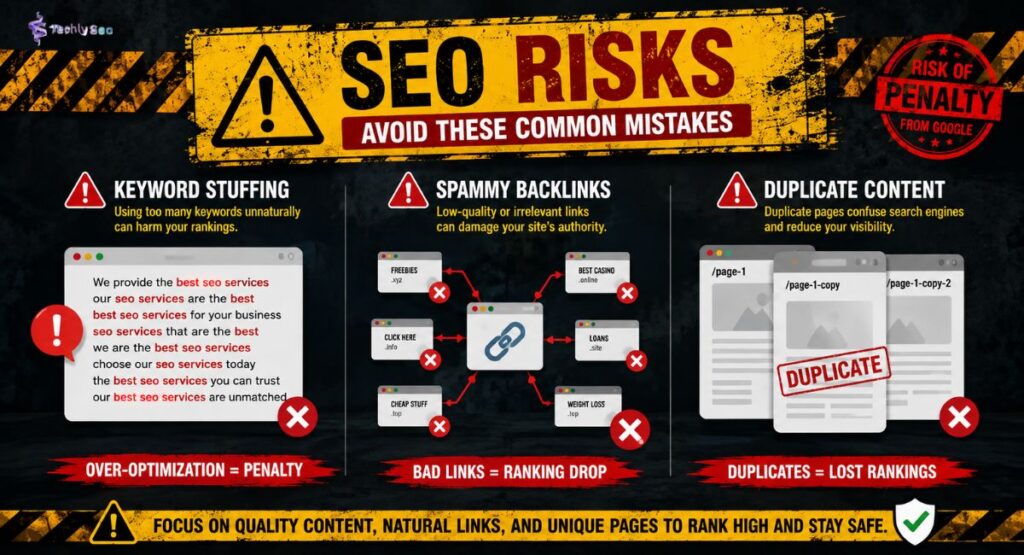
One common mistake is building dozens of nearly identical city pages. Another is stuffing keywords into every heading. Contractors also lose opportunities when they ignore technical problems, publish thin content, or track Google rankings without tracking enquiries. Search performance means little when visitors arrive but never call or request a quote.
Riskier shortcuts include purchased spam links, hidden text, misleading pages, and other black-hat SEO tactics. Google warns that spam-policy violations may reduce visibility or remove pages from its index. Sustainable SEO success comes from useful information, technical quality, accurate business details, and steady improvement. (Google for Developers)
Contractor SEO Mistakes at a Glance
| Mistake | Why it causes trouble | Better approach |
| Keyword stuffing | Makes content awkward | Write naturally around intent |
| Duplicate location pages | Gives visitors little unique value | Add genuine local information |
| Buying large link packages | Can create spam risk | Earn relevant links |
| Ignoring mobile visitors | Hurts usability | Use responsive design |
| Tracking rankings only | Hides business performance | Track leads and revenue |
| Thin service pages | Fails to answer questions | Add useful project knowledge |
How Long Does SEO Take for Contractors and How Do You Measure Results?
There isn’t one fixed SEO timeline. A new site in a competitive metro area may need more work than an established company with strong local recognition. Competition, technical condition, content depth, authority, service area, and previous SEO activity all affect the pace of SEO results. Google also states that no SEO can guarantee a number-one ranking. (Google for Developers)
Measurement should begin before major changes. Set up website tracking for calls, forms, quote requests, and other useful actions. Then compare them with website traffic, queries, landing pages, and local visibility. Search Console reports clicks, impressions, average CTR, and average position, making it a useful foundation for campaign tracking. (Google Support)
Contractor SEO Metrics That Actually Matter
| Metric | What it shows |
| Search impressions | How often pages appear |
| Organic clicks | Visits earned from search |
| Average position | General ranking movement |
| Qualified leads | Enquiries with real potential |
| Calls and forms | Conversion activity |
| Booked jobs | Leads that become business |
| Revenue | Financial value |
| Return on investment | Value compared with SEO spending |
A rising first page of Google presence may look exciting, yet business owners should ask a harder question: did it create profitable work? An SEO investment makes more sense when reporting connects visibility to calls, estimates, sales, and revenue rather than presenting traffic as the final goal.
How to Choose the Best SEO Services for Contractors
Good SEO services for contractors should begin with your business, not a generic checklist. A capable SEO agency should ask about services, profitable jobs, service areas, competitors, customers, and current problems. Google recommends asking potential SEO providers about previous work, industry experience, expected results, measurement methods, and communication. (Google for Developers)
Choose a contractor SEO agency that explains its work clearly. Ask what will change on your website, who owns the content, how links are earned, and how leads will be tracked. Be careful with anyone promising instant rankings. Google explicitly says that no one can guarantee a number-one position. (Google for Developers)
What a Strong Contractor SEO Partner Should Measure
The right partner should connect digital marketing activity with commercial outcomes. Reports should show changes in search engine rankings, website traffic, enquiries, calls, and revenue where tracking allows it. Transparent reporting also helps you decide which services deserve more attention and which pages need further improvement.
Final Thoughts on Growing Your Contracting Business with SEO
A successful contractor search strategy doesn’t rely on one trick. It combines useful service pages, strong local information, technical health, reviews, trusted links, and accurate measurement. SEO for contractors works best when every improvement helps both search technology and real customers understand why your business is relevant.
Treat SEO as part of lead generation, not a competition for vanity metrics. Strong online visibility matters because it brings the right people closer to your business. When your contractor customers can quickly understand your services, trust your experience, and contact you without friction, traffic has a much better chance of becoming revenue.
For a USA contractor, the smartest place to start is usually the services and locations that matter most commercially. Strengthen those pages first. Improve technical quality. Build local trust. Measure real enquiries. Then expand based on evidence. That approach creates a far healthier foundation than chasing every keyword or every new SEO trend.
FAQs
What is an SEO contractor?
An SEO contractor is a specialist who helps businesses improve their website rankings, traffic, and leads through search engine optimization.
Is SEO still worth it in 2026?
Yes, SEO is still worth it in 2026 because people continue using search engines to find products, services, and local businesses.
How much should I expect to pay for SEO?
SEO costs vary widely based on your market, competition, website size, and the level of work required.
Is paying someone to do SEO worth it?
Yes, hiring an experienced SEO professional can be worth it if they improve qualified traffic, leads, and long-term business visibility.
Can I do SEO on my own?
Yes, you can handle basic SEO yourself, though technical SEO, link building, strategy, and competitive markets often require professional expertise.