
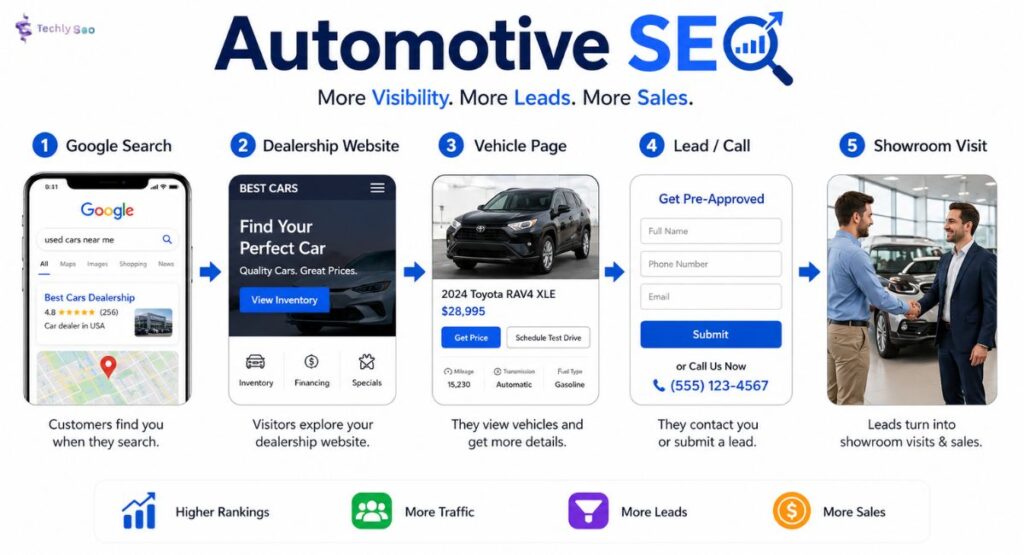
Automotive SEO helps car dealerships improve their online presence, attract local buyers, and turn search visibility into real sales opportunities. Today, shoppers compare vehicles, prices, reviews, and dealerships before visiting a showroom, so strong car dealership SEO matters more than ever.
A smart strategy combines local automotive SEO, useful content, technical improvements, and optimized vehicle inventory pages to reach buyers at every stage. It also strengthens Google Business Profile performance and overall organic visibility. When done well, automotive SEO helps your dealership appear for relevant searches, earn trust, generate qualified leads, and compete more effectively in crowded local markets online.
What Is Automotive SEO and How Does It Work?
Automotive SEO is the process of improving a dealership website so people can find it through organic search and local search. It combines keyword research, content, local optimization, technical improvements, links, and better page structure. The goal is simple: connect your dealership with shoppers when their search shows genuine interest.
Google broadly works through crawling, indexing, and serving relevant results. That means your pages first need strong site crawlability, then understandable content, and finally enough search relevance to compete for useful queries. Google doesn’t guarantee indexing or rankings even when a site follows best practices.
How Car Dealership SEO Turns Search Visibility Into Customers
Strong car dealership SEO connects different pages with different buyer needs. A research article can help someone compare SUVs. An inventory page can capture a shopper ready to buy. A service page can reach an owner who needs brake repair today. Together, those pages create a path from vehicle research to a real dealership interaction.
Think of SEO like road signs leading shoppers toward your store. One sign rarely closes a sale. Several useful signs can keep your dealership visible throughout the car buyer journey until the shopper feels ready to call, visit, or submit an inquiry.
Why Automotive SEO Is Different From Traditional SEO
The automotive industry creates SEO challenges that a normal local business may never face. Car dealerships continually add and remove vehicles. That creates changing vehicle inventory, new URLs, expired listings, duplicate pages, filtering options, and thousands of possible page combinations. Weak management can create unnecessary crawling and indexing problems.
Dealers also compete with nearby stores, large dealer groups, OEM websites, manufacturers, and third-party marketplaces such as Cars.com, Autotrader, CarGurus, and Kelley Blue Book. This is why dealership SEO needs stronger local signals, inventory management, technical control, and unique content instead of generic optimization.
Why Duplicate OEM Content Creates a Weak Search Experience
Many websites reuse OEM content for model descriptions and specifications. When hundreds of pages provide almost identical information, your dealership adds little unique value. Google recommends people-first content that offers useful information rather than pages created mainly for rankings.
A better page adds dealer-specific information. Explain available trims, local demand, ownership questions, financing choices, or practical regional vehicle preferences. That gives users a reason to choose your page instead of another copy of the manufacturer’s description.
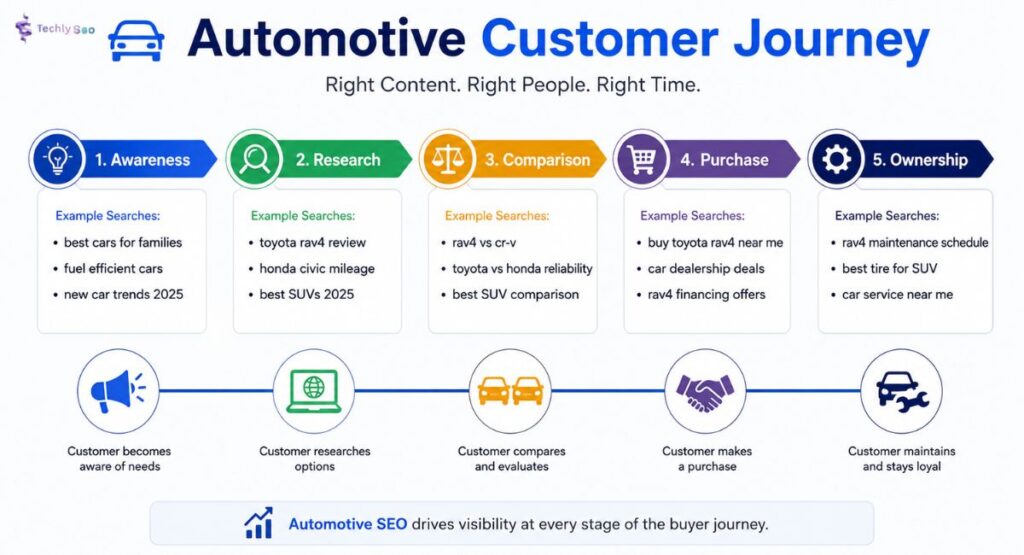
Understanding Automotive Search Intent and the Car Buyer Journey
Understanding automotive search intent helps you create the right page for the right shopper. Informational searches often happen early. Someone may ask about hybrid batteries, tire rotation, vehicle reliability, or towing capacity. These searches don’t always create an immediate sale. However, useful answers introduce your dealership during the research stage.
Later, commercial searches involve comparisons and evaluation. Someone might research Honda CR-V versus Toyota RAV4 or compare a Ford F-150 with a Chevy Silverado. Transactional searches show stronger buying intent, such as “used cars for sale in Dallas” or “car dealer near me.” Your page type should match that intent.
| Search stage | Example search | Best page type | Main SEO goal |
| Awareness | How long do hybrid batteries last? | Educational guide | Build trust |
| Research | Honda CR-V vs Toyota RAV4 | Comparison page | Support evaluation |
| Purchase | Used SUVs for sale in Houston | Inventory page | Generate inquiries |
| Local | Toyota dealer near me | Location/GBP | Drive calls and visits |
| Ownership | Brake repair near me | Service page | Book appointments |
Matching Automotive SEO Content to the Car Buyer Journey
A smart strategy doesn’t focus only on the final purchase. Buying research may start weeks before a shopper contacts you. Content about the Kia Telluride, used SUVs, used trucks, safety technology, ownership costs, and vehicle comparisons can build familiarity before the buyer chooses a dealership.
Your website should therefore support discovery, research, comparison, purchase, and ownership. This broader approach gives car buyers useful information at several moments rather than waiting for one high-intent search.
Local SEO for Car Dealerships: Rank Higher in Google Maps
Local automotive SEO matters because dealerships depend heavily on nearby customers. Your Google Business Profile can appear across Google Search and Google Maps. Google explains that local ranking mainly depends on relevance, distance, and prominence. Reviews and links can also contribute to prominence.
Complete business information supports stronger Google Maps visibility and clearer geographic relevance. Choose the correct primary business category, maintain accurate hours, use high-quality photos, and keep your dealership details consistent. Google says business categories can affect local rankings. (Google Support)
Google Business Profile Optimization for Dealership SEO
Your Google Business Profile should reflect the real customer experience. Show the dealership showroom, exterior, inventory, team, and service lounge. Keep holiday hours accurate. You can also use Google Posts to communicate offers, new services, events, or timely dealership information.
Don’t treat dealership reviews as decoration. Build a steady review cadence by asking genuine customers for feedback and responding professionally. Google confirms that verified businesses can respond to reviews and that reviews contribute useful local information.
Automotive Keyword Research for Dealerships
Automotive keyword rankings start with understanding how customers actually search. A dealership shouldn’t target only broad phrases such as “cars” or “SUVs.” Those terms reveal little intent. Stronger keyword research combines model, condition, location, price, service, and buying stage.
For example, “Toyota” is broad. “Used Toyota Camry in Phoenix” gives you far more context. “Certified Toyota Camry under $30,000 in Phoenix” becomes even more specific. These long-tail phrases can guide inventory page optimization, local landing pages, category pages, and useful supporting content.
Build Keyword Groups Around Real Dealership Revenue
Organize keywords by business purpose rather than stuffing unrelated phrases onto one page. Vehicle queries belong with inventory. Repair queries belong with service pages. Financing questions should support vehicle financing pages. Location queries should connect to genuine localized content.
This approach also prevents keyword cannibalization. Instead of several weak pages fighting over the same topic, you create one clear destination that addresses the buyer’s need in depth.
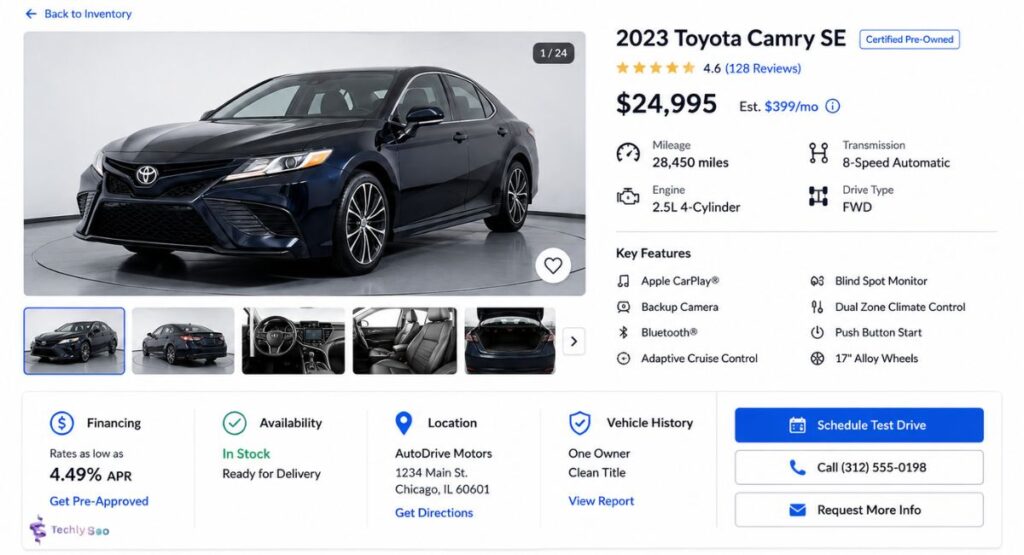
How to Optimize Vehicle Inventory and VDP Pages for SEO
Dealership inventory pages sit close to the money. They attract shoppers who may already know what they want. Every useful inventory category should provide more than vehicle cards. Explain what shoppers can expect, highlight common trims, answer buying questions, and connect visitors with financing and related models.
Individual vehicle detail pages should clearly show price, mileage, condition, specifications, availability, meaningful vehicle highlights, and a simple next action. Strong pages also use descriptive titles, useful images, clear calls to action, and accurate information. This creates better context for both users and search engines.
Handle Sold Vehicles Without Creating an SEO Mess
When inventory changes, don’t blindly delete every sold vehicle URL. First ask whether the URL still has traffic, backlinks, or useful replacement inventory. If a closely related replacement exists, a redirect may make sense. If the page has genuinely disappeared without a substitute, returning the correct HTTP status can prevent confusing search engines.
Google specifically warns that faceted navigation and URL parameters can create repetitive crawling. It also recommends using appropriate status codes when pages no longer exist.
On-Page SEO Strategies for Automotive Websites
On-page optimization helps search engines understand each page without making the writing sound robotic. Use one clear topic. Write useful titles and headings. Add descriptive text around your inventory. Connect related pages through internal linking. Google notes that crawlable links help it discover pages and understand relationships between content.
Images also matter. Optimize image sizing without ruining quality. Use descriptive file names and meaningful alternative text when appropriate. Keep button usability clear. A visitor shouldn’t need a magnifying glass and three lucky guesses to find the “Schedule a Test Drive” button.
Use Schema Markup to Describe Dealership Content
Schema markup gives machines explicit information about your content. Google’s documentation explains that structured data can help it understand page entities and may support eligible search features. However, markup doesn’t guarantee a special search appearance.
For dealership identity, Schema.org provides auto dealer schema through the AutoDealer type. Vehicle offers can also use relevant Vehicle, Product, and Offer properties. Avoid relying only on generic organization schema when a more specific type accurately describes your business. (Schema.org)

Technical SEO for Car Dealership Websites
Automotive technical SEO becomes critical when a site holds thousands of inventory and filter URLs. Poor URL structure, broken pagination, crawl traps, unnecessary filters, and duplicate content can waste crawling resources. Larger or frequently changing sites should pay particular attention to Google’s guidance on faceted navigation and crawl budget. (Google for Developers)
A clean XML sitemap can help discovery on complex sites, although a sitemap doesn’t guarantee indexing. Google also uses the mobile version of content for indexing and ranking. That makes mobile optimization, consistent mobile content, and a strong mobile user experience especially important.
Improve Page Speed Without Breaking the Shopping Experience
A dealership page may load inventory feeds, chat tools, finance widgets, analytics scripts, videos, maps, and large vehicle galleries. Each extra feature can affect page speed, navigation flow, and responsiveness.
Google’s Core Web Vitals measure real-world loading performance, responsiveness, and visual stability. Improve performance carefully. Don’t remove useful buying tools just to chase a perfect score. Instead, optimize heavy images, unnecessary scripts, and slow third-party elements.
| Technical problem | What shoppers experience | SEO concern | Practical response |
| Slow vehicle galleries | Long waits | Weak page experience | Compress and resize images |
| Filter URL explosion | Repeated pages | Crawl waste | Control faceted URLs |
| Missing canonicals | Similar URLs compete | Duplication confusion | Define preferred versions |
| Broken inventory URLs | Dead landing pages | Lost value | Redirect or return correct status |
| Weak mobile layout | Hard-to-use forms | Poor usability | Test mobile templates |
| Orphan inventory categories | Pages are hard to discover | Weak crawl paths | Improve internal linking |
Automotive Content Marketing Strategies That Attract Car Buyers
Good automotive content marketing answers questions people genuinely ask. Don’t publish another 400-word article titled “Five Reasons Cars Are Great.” Create evergreen content about ownership costs, vehicle reliability, trim differences, safety, warranties, charging, vehicle features, maintenance, and real-world buying concerns.
Your buyer-focused content can also reflect the market you serve. A Denver dealership may discuss winter driving. A Texas truck dealer may answer towing questions. An EV dealership in California may explain local charging considerations. Strong automotive local signals can make content more useful to local communities without forcing city names into every sentence.
Create Content That Helps People Choose a Vehicle
Comparison content works because buying a car often means choosing between several reasonable options. A buyer may compare a Honda SUV with a Toyota model or research whether the Ford F-150 offers enough towing capacity for a trailer.
Explain practical differences without turning every comparison into a sales pitch. Useful content earns attention because it reduces uncertainty. That trust can later support inquiries and conversions.
Automotive Link Building and Local Authority Strategies
Backlinks can help strengthen dealership link authority when they come from relevant and trustworthy sources. Google confirms that links can help it discover pages and can act as relevance signals. The goal isn’t to collect as many links as possible. Quality and context matter far more than random directory volume.
Look for genuine relationships with local events, business organizations, charities, community programs, dealerships associations, and reputable automotive publishers. Useful partnerships can create mentions naturally. Avoid manufactured link networks and irrelevant placements created only to manipulate rankings.
Build Authority Through Real Community Participation
Imagine a dealership sponsors a local high-school road-safety event. The event page mentions the business. A local news outlet covers the program. Community organizations share the resource. Those mentions make sense because the dealership genuinely participated.
That type of local authority is more defensible than buying 300 anonymous links. It also supports brand trust outside SEO, which makes the marketing investment more useful even before you count ranking gains.
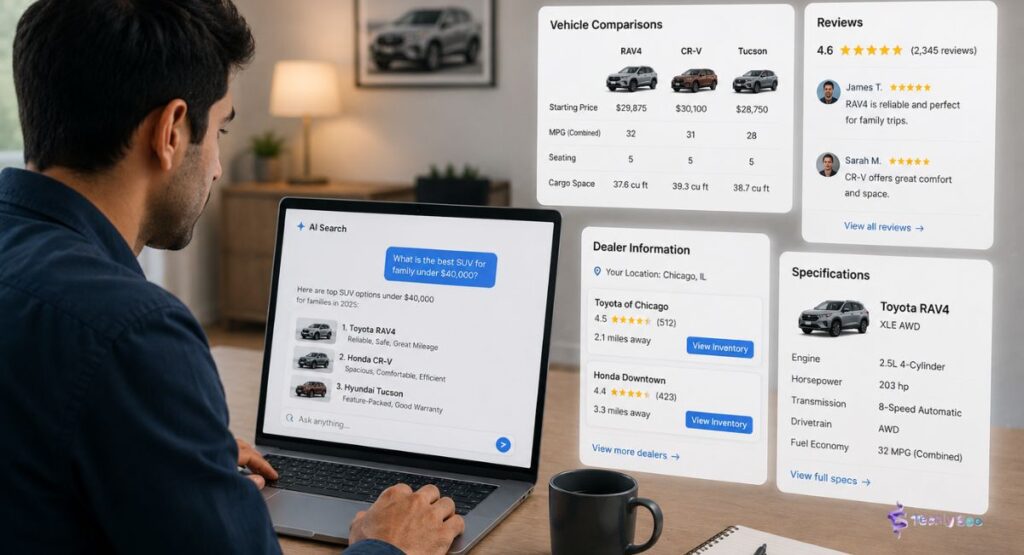
AI Search, AEO and GEO: The Future of Automotive SEO
AI search is changing how people explore complex questions. AI Overviews and other generative experiences can summarize information and surface supporting links. Tools such as ChatGPT can also influence how people research vehicles, compare models, and frame questions before visiting dealer websites.
However, dealers don’t need a mysterious new technical playbook. Google states that normal SEO best practices remain relevant for its AI features and says there are no additional requirements for appearing in AI Overviews or AI Mode.
“There are no additional requirements to appear in AI Overviews or AI Mode.” — Google Search Central
AEO and GEO Should Strengthen SEO, Not Replace It
Answer Engine Optimization and Generative Engine Optimization can help you think about clarity, entity understanding, expert answers, and content usefulness. Yet Google’s current guidance treats optimization for generative search as part of broader SEO rather than a separate set of ranking hacks.
Write clear answers. Add first-hand dealership knowledge where possible. Use accurate structured data. Keep pages crawlable. Publish original photos and useful comparisons. Most importantly, create content that deserves to be referenced instead of rewriting generic information already available everywhere.
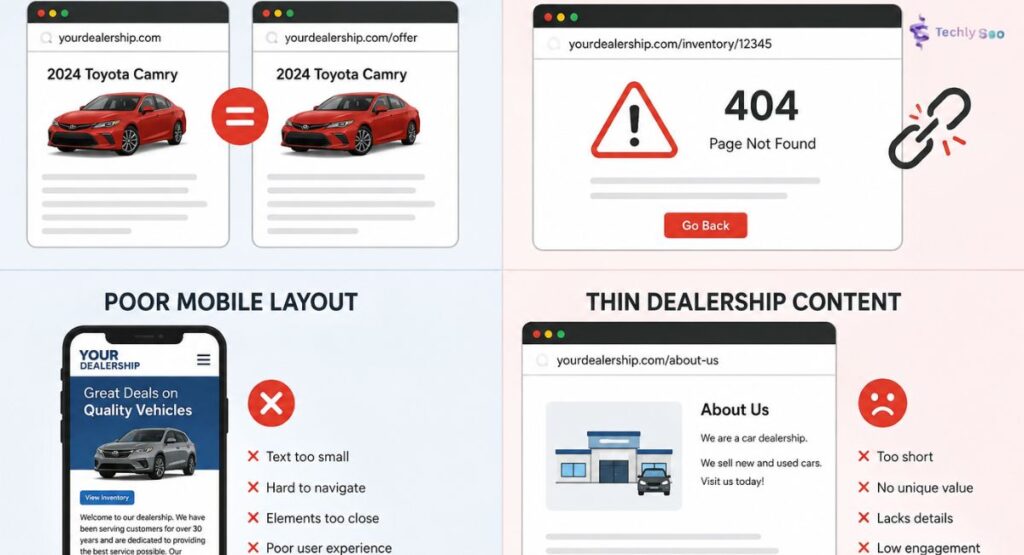
Common Automotive SEO Mistakes Dealerships Should Avoid
One common mistake is measuring success through rankings alone. A number-one ranking for a useless query can produce zero revenue. Better performance connects organic traffic with SEO conversions, phone calls, finance inquiries, test drives, and dealership visits. Traffic should support a business goal.
Another mistake is publishing thin content across hundreds of pages. Add weak OEM content, duplicated city pages, outdated inventory URLs, and poor mobile design, and the site becomes difficult for buyers and search engines. Google’s people-first guidance recommends creating content primarily for users rather than producing pages mainly to attract rankings.
Don’t Treat SEO as a One-Time Website Fix
Your inventory changes. Competitors change. Search behavior changes. Customer behavior shifts as new models, incentives, fuel costs, financing conditions, and technology enter the market.
That means dealership optimization needs ongoing review. Check search demand, inventory visibility, technical errors, local profiles, content performance, and lead quality regularly. SEO works better as an operating process than a one-time project.
How to Measure Automotive SEO Performance and ROI
Measure what moves the business. Local rankings and automotive keyword rankings provide useful diagnostic information. However, they shouldn’t become the final goal. Track whether search visitors call, request a quote, submit a finance form, start a chat, schedule a test drive, or book service.
Use Google Search Console to study clicks, impressions, queries, CTR, and search visibility. Google explains how these metrics appear in the Performance report. Then use Google Analytics to analyze traffic sources and important actions. GA4 lets businesses mark important actions as key events.
Connect SEO Metrics With Dealership Outcomes
The strongest reporting follows the path from query to sale. For example, Search Console may show increasing impressions for a used-truck category. Analytics may show more engaged organic sessions. Your CRM may then show whether those visits generated calls or vehicle inquiries.
This connects SEO with business outcomes instead of vanity metrics.
| Metric | Tool | What it tells you | Business question |
| Search impressions | Search Console | Search exposure | Are more shoppers seeing us? |
| Clicks and CTR | Search Console | Search engagement | Are listings attracting visits? |
| Organic sessions | GA4 | Website traffic | Are search visitors arriving? |
| Key events | GA4 | Important actions | Are visitors taking action? |
| Calls and forms | Call tracking/CRM | Lead generation | Are we creating prospects? |
| Appointments | CRM/DMS | Sales progression | Are leads moving forward? |
| Vehicle sales | CRM/DMS | Revenue impact | Is SEO contributing to sales? |
Google’s Traffic Acquisition report helps businesses understand where website sessions come from. That makes it useful for separating organic performance from other marketing channels.
How to Choose the Right Automotive SEO Agency
A strong automotive SEO agency should understand more than title tags. Ask how the team handles inventory turnover, faceted navigation, local visibility, VDPs, service pages, content, reporting, and technical problems. If every answer sounds like a generic small-business SEO package, the agency may not understand dealership complexity.
Transparency matters too. A useful partner should explain what changed, why it changed, what happened afterward, and what comes next. Be cautious with anyone who guarantees first place. Google itself states that following best practices doesn’t guarantee crawling, indexing, or placement in results.
Automotive SEO Agency vs Generalist Agency vs In-House Team
The right model depends on your staff, budget, dealership size, and internal skills. An in-house specialist offers daily access. A generalist can cover broad digital needs. A specialized automotive team may understand inventory systems and dealership search behavior faster.
The best choice isn’t automatically the most expensive one. Choose the team that can connect technical work with local automotive SEO, content, lead tracking, and measurable dealership outcomes.
| Option | Main advantage | Main limitation | Best fit |
| Automotive SEO agency | Specialized experience | Higher specialist cost | Competitive dealerships |
| General SEO agency | Broad SEO support | May lack dealer expertise | Smaller local businesses |
| In-house SEO | Direct business knowledge | Recruiting and tool costs | Large dealer groups |
| Hybrid model | Internal control plus specialists | Needs clear ownership | Growing dealerships |
Conclusion: Build an Automotive SEO Strategy That Drives More Dealership Sales
Winning search today requires more than changing a few title tags. Strong dealerships connect local optimization, useful inventory pages, technical health, content, links, and measurement. They understand search relevance and create pages for actual buyers rather than publishing endless SEO filler.
Start with the areas closest to revenue. Improve your inventory experience. Fix serious technical issues. Strengthen local visibility. Answer real buyer questions. Then measure whether those improvements create qualified traffic, inquiries, appointments, and sales.
That’s the real purpose of dealership search marketing. Rankings are useful. Customers are better.
FAQS
What Is Automotive SEO?
Automotive SEO helps dealerships improve visibility in Google Search and Maps so more local car buyers can find their vehicles and services.
Does SEO Work for Car Dealerships?
Yes. SEO can bring more qualified traffic, calls, leads, and showroom visits by targeting buyers at different stages of their search.
How Long Does Automotive SEO Take to Work?
Results often take time and depend on competition, website quality, local authority, content, and technical SEO.
How Much Does Automotive SEO Cost?
Automotive SEO pricing varies based on dealership size, locations, competition, website condition, and the services included.
What Is Local SEO for Car Dealerships?
Local SEO helps dealerships appear in nearby searches through Google Business Profile optimization, reviews, local pages, and accurate business information.
How Can a Car Dealership Rank Higher on Google Maps?
Keep your Google Business Profile complete, choose accurate categories, earn genuine reviews, maintain correct details, and strengthen local relevance.
Why Are Vehicle Detail Pages Important for Automotive SEO?
VDPs target specific vehicle searches and give buyers useful details such as price, mileage, features, availability, and financing options.
Is Automotive SEO Better Than Google Ads?
SEO builds long-term organic visibility while Google Ads provide paid visibility. Using both can create a stronger overall marketing strategy.
What Keywords Should Car Dealerships Target?
Target vehicle make and model terms, local searches, financing keywords, service queries, and high-intent phrases such as used cars for sale.
How Is AI Changing Automotive SEO?
AI search is changing how buyers research and compare vehicles. Dealerships should focus on useful content, clear answers, strong local signals, and technically accessible pages.